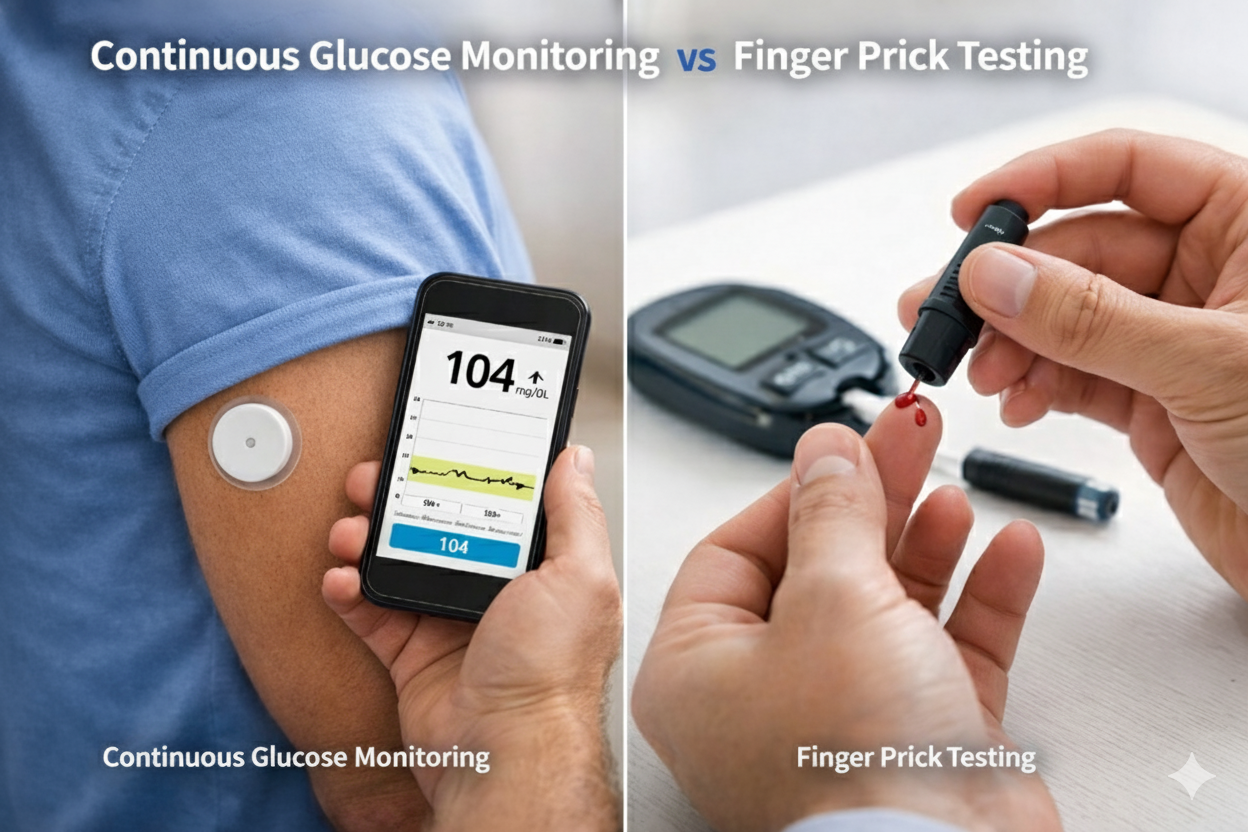
Continuous Glucose Monitoring vs Finger Prick Testing
Continuous Glucose Monitoring (CGM) tracks glucose every few minutes without needles, while
finger prick testing measures blood sugar at specific times. CGM helps detect trends, prevent highs and lows,
and improves diabetes control, while finger testing remains useful for spot checks.
Introduction
Blood sugar monitoring is the foundation of good diabetes management. Traditionally, people relied on
finger prick glucose monitors to check their sugar levels. Today, Continuous Glucose Monitoring (CGM)
has transformed diabetes care by offering real-time insights and better control.
Patients often ask:
- Is CGM more accurate than finger prick?
- Which is better: CGM or glucometer?
- Do I still need finger prick testing if I use CGM?
- Is CGM good for Type 2 diabetes?
This blog provides a complete comparison of Continuous Glucose Monitoring vs Finger Prick Testing,
including benefits, accuracy, usage, and how to choose the right option.
⭐ What Is Continuous Glucose Monitoring (CGM)?
A CGM device tracks glucose levels 24/7 using a small sensor placed on the arm or abdomen.
CGM provides:
- Real-time glucose readings
- Trend arrows (rising or falling sugar)
- High and low glucose alerts
- Graphs showing daily glucose patterns
- Insights for diet, exercise, and medication adjustments
Popular CGM devices include:
- FreeStyle Libre
- Dexcom
- Medtronic Guardian
What is a CGM device and how does it work?
A small sensor continuously reads glucose levels from interstitial fluid.
⭐ What Is Finger Prick (Glucometer) Testing?
Finger prick testing, also called Self-Monitoring of Blood Glucose (SMBG),
involves pricking the finger and placing a drop of blood on a test strip.
Advantages:
- Quick results
- Affordable
- Highly accurate for single readings
Limitations:
- Shows glucose only at that moment
- No trend or pattern analysis
- Painful for many patients
How accurate is finger prick testing?
Very accurate for individual readings.
CGM vs Finger Prick — Key Differences
1. Number of Readings
- CGM: Around 288 readings per day
- Finger Prick: Usually 2–4 readings per day
2. Real-Time Trends
- CGM shows whether glucose is rising, falling, or stable
- Finger prick shows only the current value
3. Pain & Convenience
- CGM: Minimal pain, very convenient
- Finger prick: Repeated pricks, moderate convenience
4. Understanding Lifestyle Impact
- How meals affect glucose
- Impact of exercise on sugar levels
- Which foods cause spikes
- Morning fasting sugar patterns
Is CGM better for monitoring after meals?
Yes — CGM clearly shows post-meal glucose trends.
5. Accuracy
- CGM may lag 5–10 minutes (reads interstitial fluid)
- Finger prick measures actual blood glucose directly
Is CGM more accurate than a glucometer?
For trends: Yes. For single readings: Finger prick is more precise.
6. Hypoglycemia Detection
- CGM provides instant alerts for low sugar
- Finger prick cannot predict or alert lows
Benefits of Continuous Glucose Monitoring
- Improves HbA1c and Time in Range (TIR)
- Early detection of dangerous lows, even at night
- Helps understand food and exercise responses
- Ideal for kids, teenagers, and Type 1 diabetes
- Highly beneficial during pregnancy
Benefits of Finger Prick Testing
- More accurate for single readings
- Affordable and widely available
- No sensor insertion or calibration
- Useful to confirm CGM readings
Who Should Use CGM?
- Type 1 diabetes patients
- Type 2 diabetes on insulin
- Pregnant women with diabetes
- Children and teenagers
- People with frequent highs or lows
Who Should Use Finger Prick Testing?
- Mild Type 2 diabetes
- People on oral medications
- Occasional glucose monitoring
- Budget-sensitive users
Frequently Asked
Questions (FAQs)
1. Is CGM more accurate than finger prick?
CGM
is excellent for trends; finger prick is more accurate for single readings.
2. Do I need finger prick testing if I use
CGM?
Yes
— occasionally to confirm certain readings.
3. Is CGM good for kids and teenagers?
Yes
— it prevents highs/lows and improves safety.
4. Which is better for Type 2 diabetes?
CGM
offers better control, especially after meals.
5. Are CGM sensors painful?
No
— insertion is quick and almost painless.
6. Can CGM replace finger pricking completely?
In
most cases, yes — except for verification when needed.
Conclusion
Both CGM and finger prick testing play important roles in diabetes management.
CGM offers real-time data, trends, and alerts for better control and safety,
while finger prick testing remains valuable for precise point readings and affordability.
The best approach is often a combination of both, tailored to individual needs.